
Most honey sold in India fails basic purity tests. We break down the science of adulteration and what NABL certification actually means.
Honey adulteration is one of India's worst-kept secrets. In 2020, a CSE investigation found that 77% of honey brands sold in India had failed international purity tests — including brands with "natural" and "pure" prominently plastered on their labels.
What does adulteration actually mean?
At its simplest, honey adulteration means that something has been added to pure honey to increase volume and reduce cost. The most common adulterants are:
- C4 sugars (corn syrup or sugar cane syrup) — detected using NMR isotope ratio testing
- Rice syrup — a more recent adulterant that can fool some older tests
- Plain sugar syrup — simple dilution that's detectable via sucrose content testing
The problem with "standard" tests
FSSAI mandates a basic honey purity test — but the problem is that modern adulterants like rice syrup and NMR-detectable sugars are specifically designed to pass these basic tests. This is why NABL-accredited labs that use NMR spectroscopy and isotope ratio analysis matter.
What Organic Yellow does differently
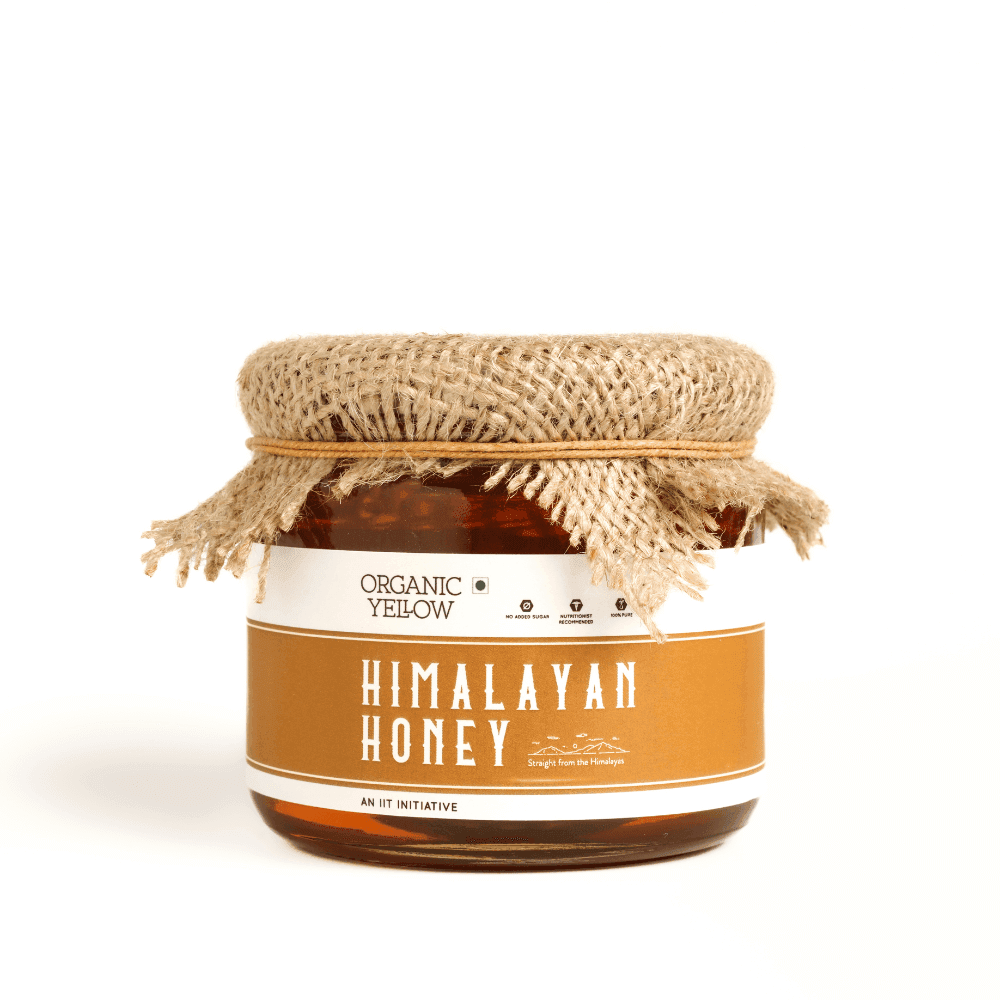
Every batch of Organic Yellow honey is tested at NABL-accredited labs across 8 parameters — including NMR-based C4 sugar testing. Our full purity scores are published on the website, and lab certificates are available on request.
Our honey is sourced directly from SHG women beekeepers in Uttarakhand and Himachal Pradesh at 4,000–6,000 ft altitude. The short supply chain means fewer opportunities for adulteration.
Simple home tests (with caveats)
The water test, flame test, and thumb test that circulate on social media are unreliable for detecting modern adulterants — rice syrup, for example, will pass all three. The only reliable test is an NMR lab test.
That said, legitimate raw honey does have some observable characteristics: it's thicker than water, it forms a thread when dropped from a spoon, and it crystallizes slowly over time. Highly processed or adulterated honey often stays liquid indefinitely.
The bottom line: buy from brands that publish their lab reports. If a brand can't show you a NABL test certificate, ask yourself why.